NetLogo Implementation of an Evacuation Scenario
The problem of evacuating crowded closed spaces, such as discotheques, public exhibition pavilions or concert houses, has become increasingly important and gained attention both from practitioners and from public authorities. A simulation implementation using NetLogo, an agent-based simulation framework that permits the quickly creation of prototypes, is presented. Our aim is to prove that this model developed using NetLogo, albeit simple can be expanded and adapted for fire safety experts test various scenarios and validate the outcome of their design. Some preliminary experiments are carried
Прямых ссылок нет — публикация используется как справочный материал.
Объём оцифровки: 22,572 знаков. Ссылки внутри текста ведут на карточки источников и публикаций библиотеки.
NetLogo Implementation of an Evacuation Scenario
Joгo Emнlio Almeida, Zafeiris Kokkinogenis                                     Rosaldo J. F. Rossetti
Artificial Intelligence and Computer Science                      Artificial Intelligence and Computer Science
Laboratory (LIACC)                                                Laboratory (LIACC)
Faculty of Engineering, University of Porto (FEUP)                Faculty of Engineering, University of Porto (FEUP)
Porto, Portugal                                                   Porto, Portugal
{ joao.emilio.almeida, pro08017}@fe.up.pt                                       rossetti@fe.up.pt
Abstract - The problem of evacuating crowded closed spaces,       goal of these studies was to develop computer animated
such as discotheques, public exhibition pavilions or concert      realistic applications, for the game industry, design
houses, has become increasingly important and gained              elements of pedestrian facilities, or planning guidelines for
attention both from practitioners and from public authorities.    architectural building and urban design.
A simulation implementation using NetLogo, an agent-based
In their common environment pedestrians tend to show
simulation framework that permits the quickly creation of
prototypes, is presented. Our aim is to prove that this model
some basic attributes. For example people always try to find
developed using NetLogo, albeit simple can be expanded and        the shortest and easiest way to reach their destination. If
adapted for fire safety experts test various scenarios and        possible they avoid detours, even if the shortest way is
validate the outcome of their design. Some preliminary            crowded. The basic principle is the "least effort principle",
experiments are carried out, whose results are presented,         which means everyone tries to reach their goal as fast as
validated and discussed so as to illustrate their efficiency.     possible spending the least amount of energy and time.
Finally, we draw some conclusions and point out ways in which     Observations made for crowds in emergency situations
this work can be further extended.                                feature typically the same patterns. As people try to leave the
building as fast as possible, the desired velocity increases
Keywords: Agent-Based Simulation, NetLogo, Evacuation          which leads to some characteristic formations. As
Simulation, Emergency Planning, Building evaluation, Egress.      nervousness increases there is less concern about comfort
zone and finding the most convenient and shortest way. It is
I.        INTRODUCTION                       observable, for example, that if people have to leave a
building in an emergency situation and they don't know the
Evacuating large crowds is a challenge under any              structure of the building well enough, they would run for the
circumstances. The evacuation from large facilities during an     exit they used as an entrance, even if other exits might be
emergency or disaster is a much more complex task because         easier to reach or even safer [1].
chaos and panic add to highly density populations even more
uncertainty and stress. Studying crowd behaviour in                   In this paper we focus our attention on the evaluation of
emergency situations is difficult since it often requires         to the architectural layout of a closed public space as it can
exposing real people to the actual, possibly dangerous,           be a museum, cinema, discotheque or concert hall. Thus are
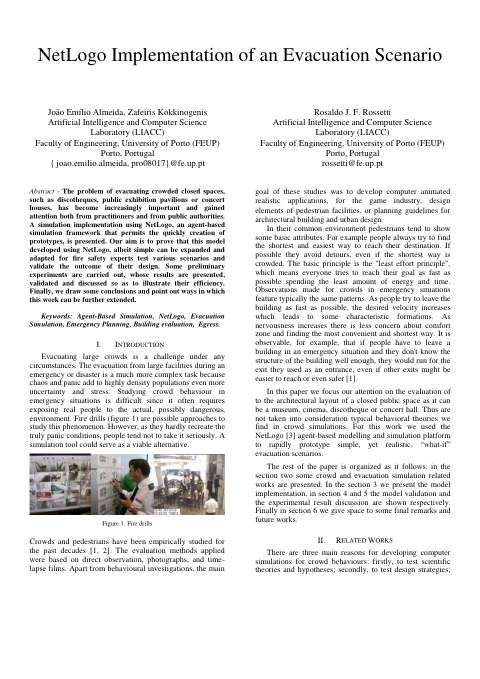
environment. Fire drills (figure 1) are possible approaches to    not taken into consideration typical behavioral theories we
study this phenomenon. However, as they hardly recreate the       find in crowd simulations. For this work we used the
truly panic conditions, people tend not to take it seriously. A   NetLogo [3] agent-based modelling and simulation platform
simulation tool could serve as a viable alternative.              to rapidly prototype simple, yet realistic, “what-if”
evacuation scenarios.
The rest of the paper is organized as it follows: in the
section two some crowd and evacuation simulation related
works are presented. In the section 3 we present the model
implementation, in section 4 and 5 the model validation and
the experimental result discussion are shown respectively.
Finally in section 6 we give space to some final remarks and
Figure 1. Fire drills                   future works.
Crowds and pedestrians have been empirically studied for                              II.   RELATED WORKS
the past decades [1, 2]. The evaluation methods applied              There are three main reasons for developing computer
were based on direct observation, photographs, and time-          simulations for crowd behaviours: firstly, to test scientific
lapse films. Apart from behavioural investigations, the main      theories and hypotheses; secondly, to test design strategies;
and finally, to recreate the phenomena about which to              changing the location and width of the exits using as metric
theorize [4]. Computer models for emergency and                    the total evacuation time.
evacuation situations have been developed and much
research on panics has been of empirical nature and carried            As agents, we defined the occupants of a closed
out by researchers from the social sciences [1, 2, 5, 6, and 7].   environment randomly distributed. All agents have the same
characteristics of adult population. Each agent will head
Santos et al. [8] offer a critical review of selected          always toward the nearest exit. If other agents occupy the
simulation models of evacuation. Also, authors have                space around him, he will wait for his turn to move on. No
identified social sciences approaches that could improve           overlapping is allowed. This scenario is quite simple but we
contemporary simulation models. They argue that social             can still observe some of the typical arching and clogging
sciences could provide important new directions to                 phenomena. The devised scenario consists on a square
simulation models of emergency evacuations. Helbing et al.         configuration of 55 x 55 patches. Considering that each
[1, 2] developed a continuous pedestrian model based on            patch has 1 m width, they will have an area of 1 m2.
plausible interactions, and pointed out that pedestrian            Therefore, the space has 55 m x 55 m = 3025 m2. Occupants
dynamics shows various collective phenomena, such as               are represented as a circle, and only one person per patch is
arching, clogging and herding [5]. According to their              allowed. Thus, the maximum occupancy density is 1 person
findings, every simulation model should reproduce such             per meter-square. An instantiation of the model can be seen
behaviours in order to be rather realistic. They believe that      in figure 2.
the above models can serve as an example linking collective
behaviour as a phenomenon of mass psychology (from the
socio-psychological perspective) to the view of an emergent
collective pattern of motion (from the perspective of
physics). Their simulations suggest that the optimal
behaviour in escape situations is a suitable mixture of
individualistic and herding behaviour. Kaup et al. [9] present
a simulation model for emergency planning and crowd
management purposes. Other simulation studies, combined
with optimization algorithms, aim at improving the
evacuation efficiency. This can be achieved in terms of
evacuation times, assessment and analysis of evacuation
plans, as well as routes/path optimizations. Coelho [10] has
deeply studied the mathematical and analytical models,
comparing and analyzing them on a systematic basis. In
Klьpfel et al. [11], the analysis of evacuation processes on-                    Figure 2. NetLogo model implementation
board is taken into consideration. Here authors apply cellular
automata to reproduce crowd motion for the detection of
possible bottleneck situations during the evacuation process.          Patches are in one of three states: inside, outside or wall.
Filippoupolitis et al. [12] address the building evacuation        Outside patches are black, inside white and the walls are
optimization problem. Su et al. [13] developed a discrete-         grey. The space limits, or walls, are special patches that
event computer simulation model for assessing evacuation           cannot be used by occupants. Exits are controlled using
programs and provide a comprehensive idea of evacuation            “sliders”, and their width might vary from 0 to 1, 2 or 3,
plans for hospital buildings in the event of a possible bomb       depending on the situations. To make this space more
threat.                                                            realistic, the exits were located following the Portuguese law
(detailed in the next section), requiring a certain number and
III.   MODEL IMPLEMENTATION                         distance between them. Some exits were placed having their
width controlled using the correspondent slider. Each
In this paper we describe the use of NetLogo as a rapid        position corresponds to a meter. So, an exit with width of 2
prototyping tool for an agent-based evacuation simulation          units means that the door has 2 meter width. If zero means
study of a closed space with the purpose to assess the             that the exit is closed and nobody can go outside through it.
building’s architectural layout in terms of evacuation times       The number of occupants is also variable. For the sake of
and occupants exit rate, only. In this section, we present how     simplification, the closed space is represented with no
our problem was modelled and which abstractions were used          obstacles inside. This happens sometimes in the real life,
to achieve it. Furthermore, complexities and constraints           when rock concerts happen in gymnasiums.
inherent to this problem were identified. From that, a
simplified model of an abstraction of the application domain           When the simulation setup starts, occupants are
was created without losing key aspects, such as certain            distributed inside the area of interest. After pressing the “go”
degrees of realism. Our purpose is to simulate the evacuation      bottom, meaning that a complete evacuation order was
of a closed space evaluating the layout of its egresses            given, for instance due to a fire or bomb threat, all occupants
considering a simple behaviour of the occupants only. The          start moving towards the nearest exit. The simulation ends
goal is to evaluate and compare scenarios’ performance,            when all occupants exit the space. The movement of each
occupant is considered to be 1 m/s. If each iteration (or tick)
lasts a second, then the occupants shall move from one patch       their respective width will depend on the expected number of
to another in each tick.                                           occupants. Passage Unit (PU) concept is basically defined
through empirical studies and determines the minimum
IV.    VALIDATION METHODOLOGY                         width through which a certain number of egresses can leave
the space safely. It is considered that for each group of 100
To the validation of the model, mathematical and               occupants one PU is required. In Portuguese Fire Code, the
empirical knowledge were used. A comparison using                  first PU is 0.9m, second 1.4m and onwards is nЧ0.6m where
common analytical models (such as Van Bogaert method or            n is the number of PU considered. For the present study, it
the Predetchenky & Milinskii formulae) was carried out to          was assumed that each PU corresponds to 1m width.
validate the data obtained through NetLogo, as explained           Another constraint regards the distribution of the exits that
below.                                                             must be independent. In other words, exits considered
independent if they are located from each other a distance far
A. The Van Bogaert analytical method                               enough to form an angle of no less than 45є to the user
The Van Bogaert [10] approach assumes that horizontal          observing both exits.
movement speed is 1.5 m/s. Total evacuation time depends               For the given example, having 1,000 occupants, the
on two main factors: total number of occupants and the flow        Portuguese Fire Code requires a minimum of 5 independent
of the exits. The maximum time to evacuate the space is            exits, with 2 PU each, resulting in a total of 10 PU (10 x
given by:                                                          0.6m = 6m width). In our example this width is 10m.
Tmax = S Ч I Ч Fd Ч H Ч R Ч 300 [s]        (1)
The components of (1) are coefficients found                             V.         EXPERIMENTAL RESULTS AND DISCUSSION
empirically, representing the various factors that influence           After setting up the model, some experiments were
the final result. S depends on the area (in this case S=3), I      carried out. Taking advantage of the random location of
reflects the building compartment (in this case is none, thus      occupants, at least three runs were performed for each
I=0.75), Fd is the density factor (Fd = 0.36 for maximum           scenario. The number of occupants was fixed to 1,000. The
density), H is related with the building height (H=1 since it      exits varied from 1 to 8, as well as varied their width PU.
is a one storey building), and R is risk type (R=1 for ordinary    The results are presented in Table I.
risks). Replacing the coefficients in (1), we have the                                  Table I. Results of experiments using Netlogo
following expression:                                                        PU          runs (seconds to exit)   exits parameters
total
Tmax = 3 Ч 0.75 Ч 0.36 Ч 1 Ч 1 Ч 300 = 243 [s]                  exits width width        #1       #2      #3 1 2 3 4 5 6 7 8                  remarks
So, according this method, the total evacuation time should           1      1     1 1261 1273 1258 0 1 0 0 0 0 0                    0    only 1 exit with 1PU
2      1     2 670 666 656 0 1 0 0 0 0 1                       0 2 opposit exits 1 PU each
be 4 minutes (or to be more precise, 243 seconds).
2      2     4 364 366 368 0 2 0 0 0 0 2                       0 2 opposit exits 2 PU each
4      1     4 358 340 356 0 1 0 1 1 0 1                       0 4 opposit exits 1 PU each
B. The Predetchenky & Milinskii method                                4      2     8 202 190 197 0 2 0 2 2 0 2                       0 4 exits with 2UP each
Predetchenky & Milinskii [10, 14] developed analytical             5      2    10 187 179 183 2 0 2 2 2 0 2                       0 5 exits with 2PU each
methods to calculate the evacuation speed of crowd. They              6      2    12 156 170 158 2 0 2 2 2 2 0                       2 6 exits with 2UP each
8      2    16 136 143 142 2 2 2 2 2 2 2                       2 8 exits with 2UP each
were the ground basis to yield the following formulae:
V = (112 Da4 − 380 Da3 + 434 Da2 − 217 Da + 5 7)/60 (2)
For each of the eight possible exits the parameter (figure
VVE = VV Ч (1,49 − 0,36 Da)                 (3)     3) value varies from 0 (meaning the door is closed) to 2, the
Where V (2) is the walking velocity [m/s] in normal            PU value.
situation and VVE (2) is the horizontal velocity [m/s] in
emergency situation. Da corresponds to the dimensionless
density given by:
Da = (NЧPh)/A                       (4)
In (4), N is the total number of persons, Ph the area
occupied by a person (typically is 0.125 m2) and A is the
area of the space in m2 (3025 m2 in the example). Replacing
the values in the equations, first in (4) Da = 0.041322, then in
(2) V = 0.81246 m/s and VVE = 1.19848 m/s.
C. The Portuguese fire code
The Portuguese Fire Code considers, regarding the exits:
a) the maximum distance from any given point to the nearest exit; b) the number of exits; c) the sum of the exits width.
For this model we assume that the minimum distance Figure 3. Model parameters requirement to the exits was valid. The number of exits and
These results show that increasing the number of exits simulation of the human decision-making mechanisms, as reduces total evacuation time. There is a relation between the was suggested in [1,2]. These features will give a very exits and width, even when the total width is the same, more reliable and true perspective of an emergency case in a exits result in a shorter evacuation time. That is something closed space offering to the designers the possibility to better someone could guess by intuition. Nonetheless, using understand the dynamics that take place in such situations.
simulations such as the one presented in this work, such an From what we have experienced, our approach is feasible assumption can be demonstrated and confirmed. and may support more complex representations of this kind of applications, proving to be an important tool for designing
Considering the scenario that better represents the and validation of evacuation plans and strategies.
Portuguese Fire Codes, with 5 exits having 2 PU of width each, and running simulations three times, the results obtained were 187, 179, 183, seconds respectively (figure 4). ACKNOWLEDGMENT
Comparing the results with the validation reference methods, This project has been partially supported by FCT described previously, the simulation speed was 1 m/s, (Fundaзгo para a Ciкncia e a Tecnologia), the Portuguese whereas the other methods use 1.5 m/s (i.e. in Van Bogaert) Agency for R&D, under grants SFRH/BD/72946/2010, and 1.19848 m/s (i.e. in Predetchenkii & Milinskii). The SFRH/BD/67202/2009 total evacuation time, according to the Van Bogaert analytical method should be less than 243 seconds.
REFERENCES
Therefore, considering the results for the selected scenario are always smaller than that reference value, even if [1] D. Helbing, I. Farkas, P. Molnar and T. Vicsek, “Simulating of pedestrian crowds in normal and evacuation situations”, in occupants speed is slower than the other methods suggest. M.Schreckenberg, S.D. Sharma(ed.) Pedestrian and Evacuation
So the Portuguese Fire Code requirements give better results Dynamics. Springer Verlag Berlin and Heidelberg, pp. 21-58, (2001) than the other methods. [2] D. Helbing, P. Molnar, I. Farkas and K. Bolay: Self organizing pedestrian movement, in Environment and Planning B: Planning &
Design (2001)
[3] U. Wilensky, NetLogo. http://ccl.northwestern.edu/netlogo/. Center for Connected Learning and Computer-Based Modeling,
Northwestern University. Evanston, IL (1999)
[4] X. Pan, C.S. Han, K. Dauber and K.H. Law, A multi-agent based framework for the simulation of human and social behaviors during emergency evacuations. AI & Society (2007)
[5] C. W. Reynolds, Flocks, Herds, and Schools: A Distributed
Behavioral Model. Proceedings of SIGGRAPH ’87, Computer
Graphics, 21(4), pages 25-34, July (1987)
[6] A.L Coelho, Modelaзгo de Evacuaзгo de Edifнcios Sujeitos а Acзгo de um Incкndio (in Portuguese). Ph.D. Dissertation, LNEC, Lisboa
Figure 4. Simulation results (1997)
[7] E. Cordeiro, A Influкncia do Comportamento das Pessoas e suas
VI. CONCLUSIONS AND FUTURE WORK Limitaзхes na Evacuaзгo dos Edifнcios (in Portuguese), LNEC,
Lisboa (2009)
In this paper we presented an evacuation model [8] G. Santos and B.E. Aguirre, A Critical Review of Emergency implemented in the NetLogo platform. Although the model Evacuation Simulation Models. NIST Workshop on Building may appear to be simplistic, its conceptualisation Occupant Movement during Fire Emergencies June 9-10. National encompasses some aspects of the observed system in the real Institute of Standards and Technology, U.S. Department of
Commerce (2004) world. As such, we are able to observe typical emerging
[9] D.J. Kaup, T.L. Clarke, L. Malone and R. Olosn, Crowd Dynamics behaviour patterns during evacuation situations, namely Simulation Research. Proceedings of the Summer Computer arching, clogging and other herding phenomena. The Simulation Conference. Calgary, Canada, pp. 365-370. (2006) proposed model presents a satisfactory degree of validity [10] A.L Coelho, Incкndios em Edifнcios (in Portuguese). Ediзхes Orion, within a plausible range of situations. In order for the model Lisboa (2010) to achieve higher degree of validity, more realistic features [11] H. Klьpfel, T. Meyer-Koning and J. Wahle, Microscopic Simulation should be incorporated, both in the agent behaviour model as of Evacuation Processes on Passenger Ships well as in the representation of the environment. Regarding [12] A. Filippoupolitis, E. Gelenbe, D. Gianni, L. Hey, G. Loukas and S.
the environment, different layouts should be taken into Timotheou, Distributed Agent-based Building Evacuation Simulator.
account (including rooms, hallways and obstacles). It will Proceedings of the Summer Computer Simulation Conference.
Edinburgh, Scotland, pp. 46- 53. (2008) be very desirable the implementation of a realistic
[13] S. Su, S.T. Tsai, C.L.Shih, R.J.Kuo, H.C.Wang and J.C.Chen, Use of fire/smoke diffusion model as well, where heat, visibility Computer Simulation in the Evacuation System for Hospitals.
and smoke can be accounted for. This ultimately would Proceedings of the Summer Computer Simulation Conference.
influence occupant’s decisions as their cognitive abilities Edinburgh, Scotland, pp. 205-212. (2008) would be also affected. Another important issue is the [14] V.M. Predtechenskii and A.I. Milinskii. Planning for Foot Traffic in development of a social force and psychological model to Buildings. Amerind Publishing Co. Pvt. Ltd., New Delhi (1978) represent the agent internal state providing a more realistic